
By Tadas, Master Colourist at Fluff
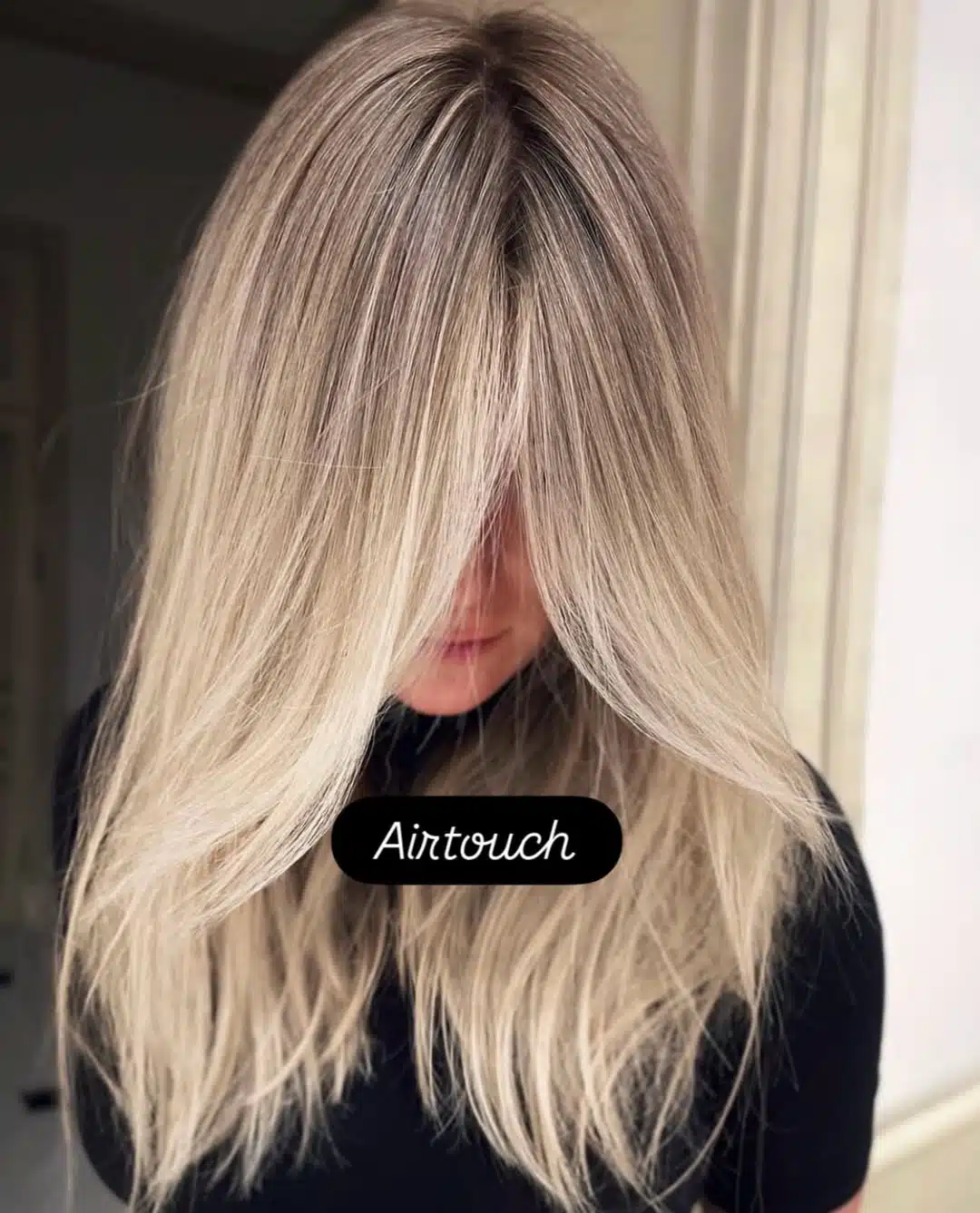
Header photo: AirTouch colour by Tadas at Fluff. View the original Fluff post.
A client sits down, lifts her hair at the crown, and shows me the line. Sometimes there are two or three of them, stacked like rings in a tree, each one a different visit. She usually asks the same thing before I say a word: do I have to start over?
Almost never. I have been correcting colour since the mid 1990s, first in London, then Los Angeles, and now at Fluff. Banding is one of the most common problems I see, and one of the most satisfying to fix, because the solution is about placement, not about piling on more bleach.
Why highlights band in the first place
A band is a record of where lightener started and stopped. Every highlight appointment begins at the new growth, and every time the lightener overlaps hair that was already lifted, that overlap gets a little brighter than the rest. Do that over several visits and you get stripes of different brightness running across the head.
The other common causes are quieter:
- Foils placed in exactly the same partings every visit, so the same strands keep getting lifted
- Saturation that changes from root to mid length, leaving a warm ring where the product ran thin
- Waiting too long between visits, so the regrowth is wide and the line is hard
- Different toners at different salons, each one leaving its own shade behind
The question behind the question is not how to make the line disappear. It is how to make the hair read as one continuous colour again without damaging the lighter sections that are already fragile.
How I correct it with AirTouch
I look at banding with the hair dry and in the brightest light we have. Wet hair hides a band, and so does a blowout under warm bulbs. I want to see every line, how wide it is, and whether it runs warm or cool, before I mix anything.
Then I use AirTouch to break the line up. Each section is blown with the dryer before I lighten it, so the shorter and finer hairs lift away and only the longer strands stay in the section. That means the strands I lighten are chosen by the hair itself, not by a straight parting. A hard horizontal line becomes a soft scatter of light, and the eye stops reading it as a band.

AirTouch is the best way I have found to create babylight dimension at the new growth while brightening the length and ends in one fell swoop. It gives the result of a tease with no need to tease, and it is much more gentle.
Tadas, on Instagram
Here is the part most people never hear: I almost never take lightener over the old line. I stop short of it and let the colour meet there through a gloss. Overlapping fresh lightener onto old blonde is how the band was made in the first place, and it is also where hair breaks. The bright ring gets a deeper, softer tone painted into it, the dark ring gets the AirTouch lift, and the gloss pulls the two into one shade.
Bond builder goes into every bowl of lightener. On a correction, protecting the strand comes before chasing the last bit of brightness.
One visit or two
A single band on healthy hair is usually a one visit fix: AirTouch through the darker section, a toned blend over the bright ring, and a gloss to finish.
Several bands, a band sitting on top of old box dye, or ends that are already stretched need two visits. I space them two to four weeks apart so the hair has time to recover before I lift again. The first visit takes out the worst of the contrast, and the second refines tone and places the last of the brightness where it belongs.
I tell clients which one they are looking at during the consultation, before any colour goes on. If I can get you there in one visit without risking the hair, I will. If I cannot, I will say so and show you why.
If you are living with a band right now
Please do not book a full head of foils to cover it, and do not reach for a box of colour. Both add another layer to the problem, and every extra layer makes the correction longer.
Instead, take a photo of your hair dry, in daylight, from the back. Bring it along with one or two photos of the colour you actually want. That is everything I need to start a plan.
You can read more about how we approach colour correction at Fluff, see more of my work, or book a correction consultation and we will look at it together.