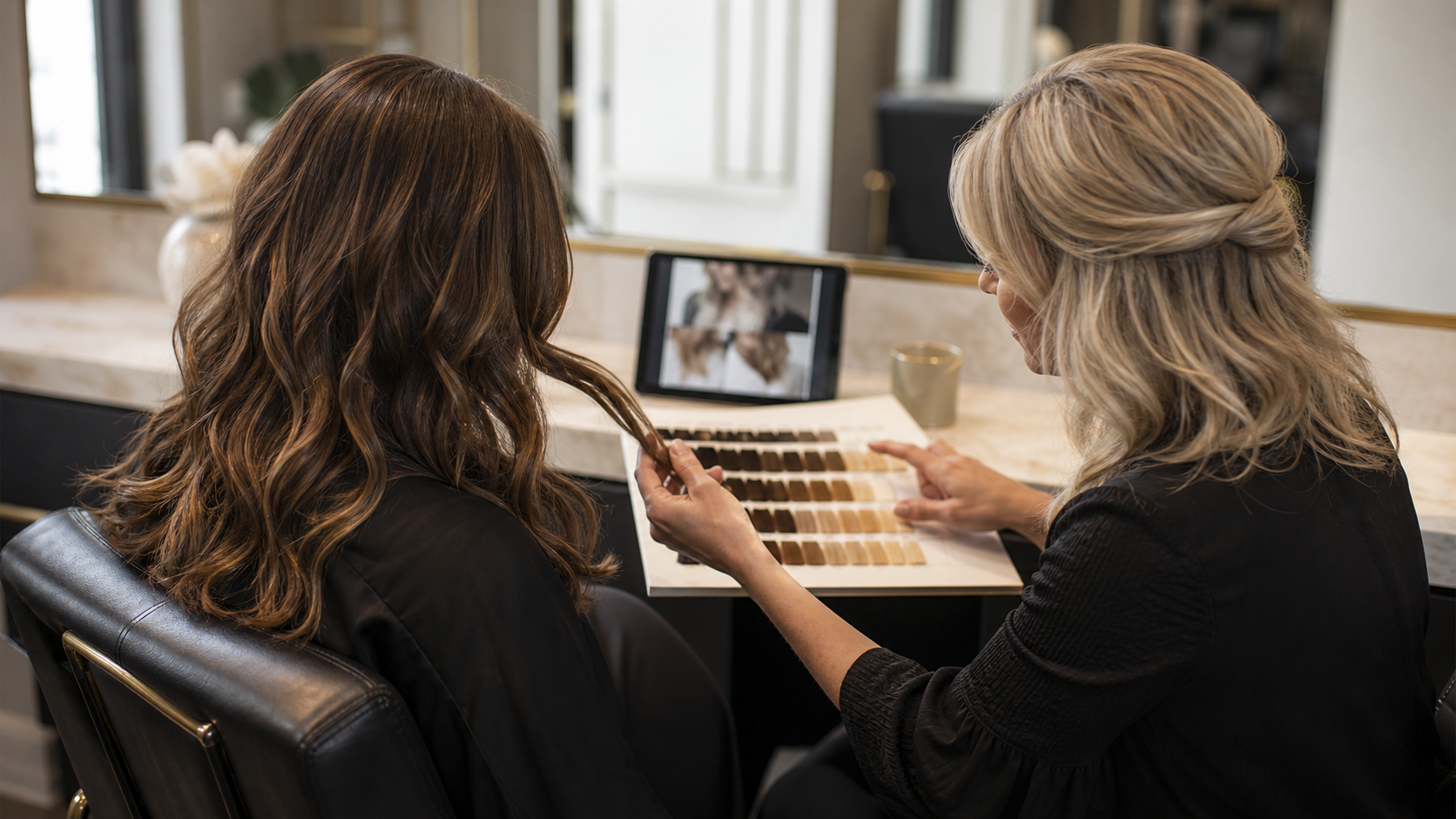
A hair colour consultation is the appointment before the appointment. Fifteen to thirty minutes in a chair with a colourist, a mirror, and a set of reference photos on your phone, where the goal is to agree on what the finished hair is going to look like, what it’s going to cost, how long it’s going to take, and what you’re going to do at home to keep it looking that way. Done well, the consultation is the reason a colour result lands. Done poorly or skipped entirely, it’s the reason so many clients end up disappointed and back in the chair a week later for a fix.
At Fluff Colour Salon in Denver, every new colour client starts with a consultation. Either as a short appointment before the service or as a dedicated pre-consultation for bigger projects like colour corrections and major transformations. This is what actually happens in that conversation, why it matters more than the brand of colour on the shelf, and how to get the most out of yours.
Most colour mistakes are communication mistakes. The consultation is where we catch them, not the chemistry.
What a consultation actually covers
A real consultation has four parts, and if any of them get skipped the result is going to wobble. The first part is your history. What’s been on your hair in the last eighteen months. Box dye, semi-permanent refreshes, henna, direct dyes, keratin treatments, extensions, relaxers, anything that was applied to your strands by anyone including yourself. This isn’t a test. It’s triage. Box dye at home two months ago changes the plan completely versus hair that’s been untouched. Most clients don’t volunteer this information unless you ask specifically, which is why we ask specifically.
The second part is the hair itself. A good colourist will lift strands at the crown, midshaft, and ends, check for porosity differences between regrowth and the lengths, look at natural depth and underlying warmth, and check elasticity by stretching a wet strand. Some colourists run a fine-tooth comb through to feel where the hair hangs up and where it’s gummy. None of this is cosmetic. It’s the data that determines whether the colour we want to do is actually possible in one session or whether we need to plan a multi-visit trajectory.
The third part is the target. This is where your reference photos matter. Not because we’re going to copy them exactly, but because they give us a shared visual vocabulary. A client who says “caramel balayage” and a colourist who hears “caramel balayage” can be picturing two very different heads of hair. Photos pin it down. We’ll often scroll through your saved images together, sort them into “yes this is exactly what I want,” “this is close but I’d want it warmer or cooler,” and “this is not what I want at all.” That sorting exercise is worth more than a hundred adjectives.
The fourth part is the plan. Given where the hair is now, where you want it to go, and what we can responsibly do, we’ll write out the appointment length, the service, the price, and the home-care routine that makes the result stick. For anything bigger than a root touch-up, we’ll also tell you whether this is a one-session project or a multi-visit one, and how those visits space out. That plan goes on the booking so we’re on the same page before you show up with wet hair.
Before, during, after
Before you come in
Save eight to ten inspiration photos to a single folder on your phone. Arrive with clean, dry, unstyled hair so we can see the real colour and texture. Write down every product you currently use, including shampoo brand, conditioner, any leave-ins, and heat tools. Note any chemical services in the last eighteen months. If you wear extensions or a topper, tell us when you book, not when you arrive.
During the consultation
We’ll scroll through your references together, sort them into yes/close/no, look at your current hair in natural light, and do a quick elasticity and porosity check. We’ll talk through maintenance, how often you want to come in, and your realistic monthly budget. You’ll leave with a written plan that shows service, price, time, and the home-care products that hold the colour.
After the consultation
You’ll get an appointment booked for the actual service with all the time and developer we need already blocked. If it’s a multi-visit project, we’ll map the first two or three appointments so you can plan around them. If it’s a colour correction, we’ll send the full plan and price by email before you confirm. No surprises at check-out.
Reference photos: the art of picking the right ones
Most clients show up with one photo of a celebrity whose hair they love. That’s fine as a starting point, but it isn’t enough. The problem with a single photo is that you can’t tell what’s colour, what’s lighting, what’s an extension piece, and what’s a post-production filter. Celebrity editorial shots are almost universally colour-graded in post, which means the hair on the red carpet and the hair on your phone screen are two different pieces of information.
Eight to ten photos is a better starting set, and we ask for that range for a reason. With ten references we can see what’s consistent across all of them. If eight out of ten have a cool-beige undertone, that’s a real signal. If the warmth varies across the set, we can pick apart what you actually want versus what’s inconsistent lighting. We also look for the hair closest to your own in length, density, and starting level, because that’s going to be the most useful visual predictor of how the colour will land on you.
If you want to be especially useful to your colourist, include two or three photos of hair you do not want. The contrast is often more clarifying than the aspiration alone. Knowing you want warm honey tones is one thing. Knowing you want warm honey tones but absolutely do not want brassy orange is a tighter target to hit.
The budget conversation
The part of the consultation clients brace for and colourists sometimes dodge. Price comes up because it has to. Single-process colour, partial highlights, full highlights, balayage, colour corrections, and extension work all live at different price points. The ongoing cost matters just as much as the first appointment. Highlights refreshed every ten weeks is a different financial commitment than balayage refreshed every four to five months. A full blonde transformation is a different commitment than lived-in warm brunette.
We walk through the first appointment price and the ongoing maintenance cadence during the consultation, because knowing what you’re signing up for matters. If the maintenance cost doesn’t fit your life, the colour plan isn’t the right plan regardless of how gorgeous it would look. A good colourist will pivot to something that suits your real maintenance window rather than sell you an appointment that’s going to grow out awkwardly because you’ll put off the refresh.
When the answer is “not in one session”
Sometimes the honest answer is that the colour you want isn’t responsibly doable in a single appointment. Going from deeply box-dyed dark brown to icy blonde is the most common example. So is taking a previously henna-treated head toward cool tones, or lightening hair that’s already been compromised by heat and over-processing. In those cases a good colourist will map a trajectory. Session one gets us partway there with safe parameters. Session two builds on it. Session three or four lands the final result.
This is the part of the consultation where clients can feel disappointed. Hearing that your transformation is a three-visit project instead of a one-day result isn’t what anyone wants to hear. But it’s the honest version, and the alternative, forcing a one-day result on hair that can’t handle it, is how breakage happens. The payoff is a result that actually lands, with hair still healthy enough to style and maintain.
The Denver factor
Denver changes the plan in ways clients don’t always expect. Our altitude means hair dries faster between the bowl and the chair, which affects processing timing. The hard water deposits mineral buildup that can shift colour tones unpredictably, particularly on blondes. The dry climate dehydrates hair year-round, which means a colour plan that works in humid coastal cities can fall apart here without the right home-care system. We factor all of that into the consultation, because a colour that looks perfect leaving the salon and brassy by week three isn’t a successful result.
Most of the clients we see who have had disappointing colour results in Denver weren’t badly coloured. They were coloured without the Denver variables being part of the plan. Consultation is where we catch that.
Questions to ask your colourist
You’re allowed to interview your colourist. In fact you should. Here are the questions that separate a thoughtful consultation from a check-the-boxes one.
“Given my current hair, is this realistic in one visit or will it take more than one?” A colourist who says yes to everything without asking about your history should worry you. A colourist who maps a multi-visit plan when your hair calls for it is showing their work.
“How often will I need to come in to maintain this?” The answer should be specific to the service. Root touch-ups every six to eight weeks, balayage every four to five months, glosses between visits. If the answer is vague, the plan is vague.
“What does the home-care routine look like?” Colour longevity lives and dies by home care. If the colourist shrugs off this question, the colour isn’t going to last. If they pull specific products off the shelf and explain what each one does, that’s the sign you’re in the right chair.
“What does this cost, and what’s the maintenance cost over the next year?” Both numbers matter. The first appointment price is easy to quote. The annual commitment takes a colourist who actually thinks about their work as a long-term plan instead of a single transaction.
“What could go wrong, and what’s the plan if it does?” Any colourist worth booking has thought about this. Uneven lift, unexpected underlying pigment, colour that pulls too warm or too cool. The answer shouldn’t be “nothing will go wrong.” It should be “here’s what we’d do if it did.”
Frequently asked questions
Is a hair colour consultation free at Fluff?
For most new clients, yes. We offer a complimentary short consultation for clients booking standard colour services. For colour corrections, major transformations, or extension-plus-colour projects, we do charge a dedicated consultation fee, which is then credited back against the service when you book. That fee is how we protect colourist time for work that genuinely requires it, and it ensures the client gets a detailed plan in writing before committing to a big appointment.
How long does a consultation take?
Fifteen minutes for a straightforward new-client assessment. Thirty to forty-five minutes for a colour correction or transformation consultation where we’re working through history, mapping sessions, and writing a full plan. If you’re coming in for the short version, we’ll often do it right at the start of your actual appointment.
What should I bring to a consultation?
Eight to ten reference photos, a list of the products you currently use, and your honest hair history for the last eighteen months. Come with clean, dry, unstyled hair so we can see what we’re working with. If you wear extensions or a topper, bring them or at minimum mention them when you book so we can plan for the extra time.
Do I have to book the appointment right after the consultation?
No. You’re welcome to leave with the plan and think about it. We’ll email the written plan and quote so you can review. Some clients book on the spot, some take a week to decide, and both are fine. What we ask is that once you book, you commit to the plan we agreed on rather than swerving toward a different reference photo at the chair, because the time and chemistry have been scoped for the agreed result.
What if my colourist tells me the result I want isn’t possible?
Listen to that. A colourist who says no is showing you they care about the integrity of your hair more than the transaction of the appointment. Most “impossible in one visit” situations are actually “possible across three visits with a proper plan.” Ask what the multi-visit version looks like. If the answer is thoughtful, that’s the colourist you want.
Book a consultation at Fluff
Fifteen to forty-five minutes, a real plan in writing, and a colour trajectory built for your hair and your life. Walk in with questions and leave with answers.
Hair Colour Consultation Denver FAQ
Three questions clients ask most about a hair colour consultation denver appointment, with our candid answers from the chair at Fluff Colour Salon in LoDo Denver.
Is a hair colour consultation denver clients book free?
At Fluff a hair colour consultation denver clients book is complimentary for new clients. We use the time to assess hair, discuss goals, and build a plan rather than rushing into service.
How long does a hair colour consultation denver appointment take?
A hair colour consultation denver clients book at Fluff runs twenty to thirty minutes. Corrective colour consultations run longer because we need to assess condition and history carefully.
What should I bring to a hair colour consultation denver?
Bring three to five reference photos, an honest read on your maintenance schedule, and any product list or colour history if available. The more information, the better the plan.