
Denver water isn’t the worst in the country, but it isn’t gentle either. The supply that comes out of most taps in the metro sits in the moderately-hard to hard range — around 120 to 180 parts per million of calcium and magnesium carbonate, with iron, copper, and chlorine running through it on top. Over months and years, those minerals bind to the hair shaft, and the symptoms show up quietly: fresh colour that fades faster than it should, blonde that keeps pulling warm no matter how many purple shampoos you throw at it, a weight or flatness that makes even good hair feel dull.
We see the full effect in the chair every week — a guest comes in frustrated that the ashy balayage we put in six weeks ago already looks brassy, and when we lift a section to check, there’s a clear mineral film along the cuticle that no shampoo is going to wash out. The colour didn’t fail. The water did. This piece is what we actually tell those clients: what hard water does to hair, how to tell if it’s what’s going on with yours, and the short list of things that genuinely help.
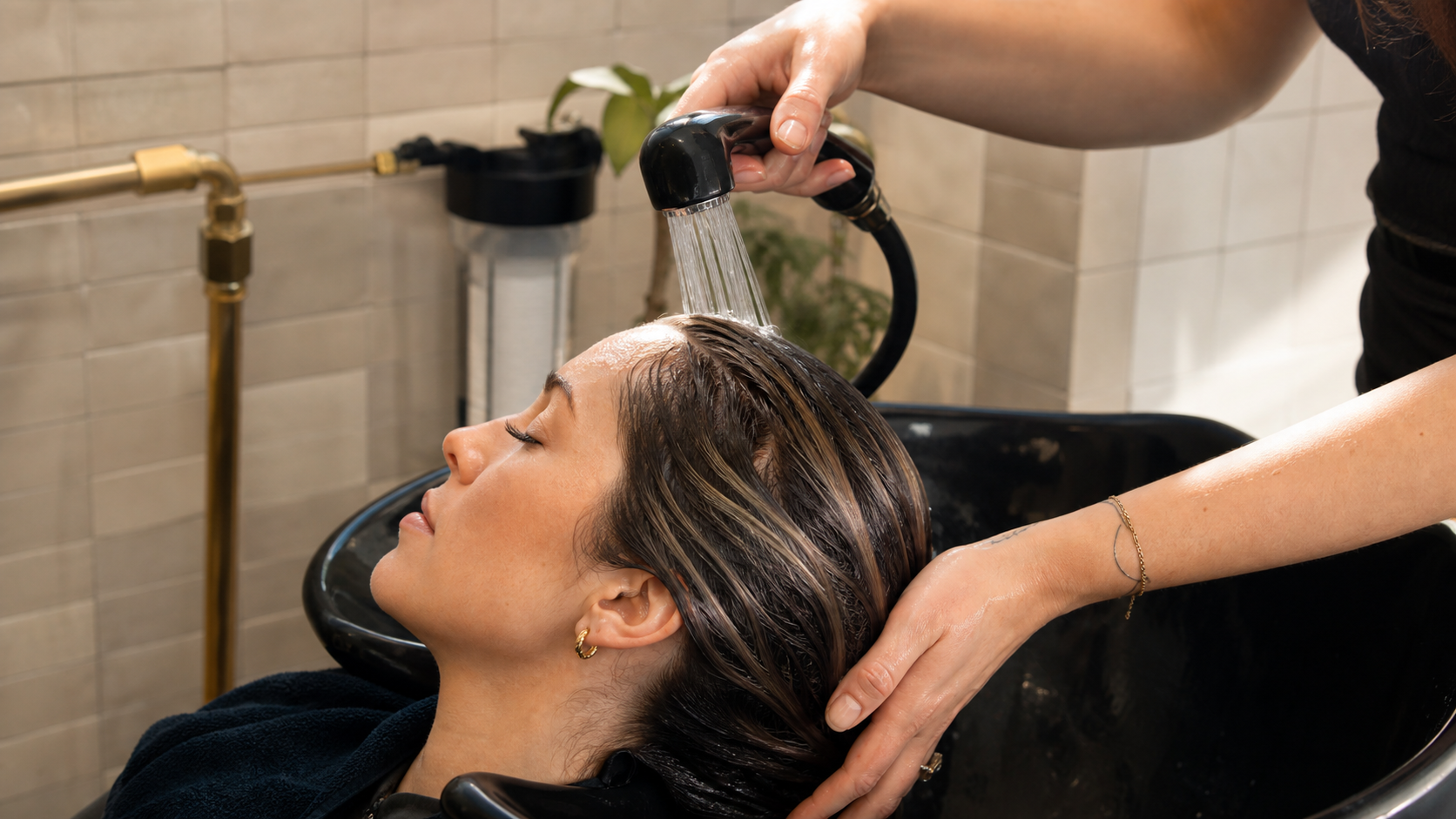
“Denver sits between 120 and 180 ppm on most days. That’s enough mineral to shift a balayage a full tone warmer by week six.”
What’s in Denver water and why it matters
Denver Water draws from the South Platte, Fraser, Williams Fork, and Blue River watersheds. The supply is treated to drinking-water standards, which is a different standard than “easy on hair.” What comes out of the tap is water that’s picked up calcium and magnesium on its journey down from the mountains, with added chlorine for disinfection, trace iron from older cast-iron service lines in some neighborhoods, and occasional copper from household plumbing. Most of Denver falls between 120 and 180 ppm on a standard water-hardness test. Anything above 120 ppm is classified as “hard.”
When hard water hits the hair shaft, the minerals do two things. First, they deposit onto the cuticle and into any porous sections — which on coloured hair means mid-lengths and ends, the same spots where lightener and colour have already opened the cuticle to do their work. Second, they react with the copper and iron present in trace amounts to oxidise, which is where you get the orange or brassy cast on blonde hair and the dull, flat quality on darker hair. Chlorine compounds the problem by drying the cuticle and locking the minerals in.
How to tell hard water is the problem
Hard water damage is one of those things that looks like something else until you know what you’re seeing. A few patterns we flag in the consultation that almost always trace back to water rather than colour:
Blonde that won’t stay cool. You leave the salon with an ashy or cool-toned blonde, and within three to four weeks it’s pulled warm or brassy. If you’re using a purple shampoo at home and it’s not holding, the issue usually isn’t the shampoo — it’s that minerals on the cuticle are reacting with the trace copper and iron in the water faster than the toner can keep up.
Hair that feels heavier than it should. Mineral buildup physically weighs hair down. If your hair feels flatter at the roots a few days after washing, or your blow-dry doesn’t hold volume like it used to, mineral load is often the explanation, especially if you moved to Denver from a soft-water region and noticed the change after.
Rust-coloured rings on a white bathtub. If your tub or shower has orange or reddish staining around the drain or waterline, that’s iron and copper in your supply. The same minerals are depositing on your hair. Neighborhoods with older plumbing — Park Hill, Cherry Creek, parts of Capitol Hill — tend to see more of this than newer builds.
Products stop working as well. Your conditioner doesn’t feel as slippery. Your leave-in seems to sit on the surface. Hard water interferes with surfactants — the cleansing agents in shampoo — which means they don’t rinse as cleanly and can leave residue that mimics product buildup.
Three fixes that actually work
1. A shower filter
The single highest-impact fix. A KDF-and-carbon combo shower filter removes chlorine, much of the copper and iron, and reduces hardness noticeably. Expect $40 to $90 upfront and a replacement cartridge every six months. Jolie and AquaBliss are the two we see most often in clients’ bathrooms.
2. A monthly chelating wash
Chelating shampoos contain EDTA or phytic acid, which bind to mineral deposits and lift them off the hair. Use once a month — not weekly, or the hair gets stripped. Malibu C Crystal Gel and Ion Hard Water Shampoo are the two we recommend most. Follow with a deep conditioner the same session.
3. An in-salon demineralising treatment
For heavy mineral load, a Malibu Crystal Gel or Malibu Blondes treatment before your colour service pulls minerals out in minutes. We add this before balayage refreshes for clients with known hard-water hair. $25 to $45 depending on length.
What we do at the salon
The first step for any guest whose colour is fading faster than it should is a Malibu treatment before the colour service. It takes 10 to 15 minutes under the dryer and pulls enough mineral off the cuticle that the tone we’re putting down actually reads true. For clients with known hard-water exposure — especially those who’ve had the same issue at a different salon — we’ll often build the Malibu into every appointment as standard rather than treat it as an add-on.
For balayage clients, we also adjust the formulation. If we know the toner is going to be fighting mineral load for the next six weeks, we’ll go slightly cooler at the bowl than the target — anticipating the warm drift rather than being surprised by it. This is a subtle thing that experienced colourists do without announcing, and it’s one of the reasons consistency matters. A colourist who’s seen your hair through three or four cycles is compensating for your specific water situation.
For extensions clients, hard water is a longer-term concern. Tape-in, hand-tied, and I-Tip extensions all sit on the hair for weeks to months, and mineral buildup on installed extensions can’t be corrected by demineralising the scalp hair alone. We counsel extensions guests on shower filtration from the first appointment and schedule a Malibu treatment at every tightening or move-up, not just at the colour refresh.
What this actually costs to fix
Shower filter upfront: $40 to $90 for the unit, another $25 to $35 every six months for the replacement cartridge. Annualised, that’s roughly $90 to $160 a year — less than two toner refreshes.
Monthly chelating shampoo: $18 to $28 for a bottle, which lasts four to six months at once-a-month use. Call it $60 to $80 a year.
In-salon Malibu treatment: $25 to $45 per session. If you add it to six appointments a year, that’s $150 to $270.
Total annual spend to keep hard water from wrecking your colour: roughly $300 to $500. Compare that to what a wasted toner refresh costs, or the frustration of watching ashy blonde go brassy by week four, and the math is straightforward. The filter alone covers most of the improvement.
Common questions
Is Denver water really that hard?
It’s in the moderately-hard to hard range — roughly 120 to 180 ppm depending on the neighborhood and time of year. That’s not extreme (parts of Arizona and Nevada run above 300 ppm), but it’s high enough to affect colour and coloured hair noticeably, and high enough that the salon visibly sees the difference after guests install a filter.
Do whole-house softeners work better than shower filters?
For mineral hardness, yes — a softener removes calcium and magnesium by ion exchange more completely than a shower filter does. But softeners don’t remove chlorine or metals like iron and copper, they’re expensive to install, and they add sodium to your water, which is its own issue. A shower filter plus a chelating shampoo covers most of what’s actually damaging hair, at a fraction of the cost.
Can a chelating shampoo replace my regular shampoo?
No. Chelating shampoos are treatment products meant for occasional use — once a month at most, in most cases. Using one weekly strips too much and dries the hair out. Pair it with a regular sulphate-free shampoo the rest of the time and a deep conditioner after every chelating session.
How soon will I notice a difference after installing a filter?
Most guests report their hair feels different after a week — softer, lighter, less flat. The bigger payoff shows up at the next colour refresh, when the toner lasts longer and the overall tone looks more true to what was put down. If you install a filter the week before a balayage appointment, you’ll see the difference clearly by week four.
Should I get a Malibu treatment before every colour?
For heavy mineral load, yes — we often build it in for balayage and blonde guests with known hard-water exposure. For dark brunettes or hair that rarely gets lifted, it’s usually fine to do quarterly rather than every visit. Ask at your consultation and we’ll tell you honestly whether your hair needs it.
Book a consultation
If your colour’s fading faster than it should, bring it to us. We’ll tell you honestly whether it’s water, product, formulation, or all three — and put together a plan to fix it.