Colour Melting vs Balayage in Denver: How to Choose

Colour Melting vs Balayage in Denver: How to Choose

Clients ask about colour melting and balayage as if they are two versions of the same thing. They are not. They share a goal, which is soft, grown-out-friendly colour that does not need touch-ups every six weeks, and they both rely on the colourist’s hand rather than foils in neat rows. But the techniques do different work, and they hold up differently in Denver’s climate, on Denver’s water, and on the kinds of hair we see through the door at Fluff.

This is the guide we use with clients who are trying to decide between the two. What balayage is for, what colour melting is for, how they feel on different hair types, and how to pick the right one for what you actually want out of your colour appointment.

The Short Version

Balayage paints the lightness. Colour melting blends the transitions. Most clients want some of both, which is why the real answer for most people is not one or the other, it’s the right combination for the look they want and the hair they have.

What balayage actually does

Balayage is a lightening technique. The colourist hand-paints lightener onto surface sections of your hair in a sweeping motion, letting it saturate from mid-shaft down and feather toward the root rather than sitting in a straight horizontal line. The result is soft, diffused lightness that sits where the sun would naturally hit, without the sharp regrowth line you get from traditional foil highlights.

What balayage is doing mechanically is lifting your hair from its current level to a lighter one, in placed ribbons. That lift is what gives you brightness around the face, dimension through the lengths, and that lived-in quality clients keep asking for by name. It’s also what determines how the service ages. Because the lightness is painted in soft pieces rather than pulled up to the scalp, the regrowth doesn’t stripe. It blurs.

Balayage alone, without a second step, leaves you with raw lifted hair. That hair usually needs to be toned afterward, either at the bowl or with a gloss, to shift it from brassy yellow into whatever shade you’re going for. That toning step is where balayage and colour melting start to overlap, because toning is where the melt often happens.

What colour melting actually does

Colour melting is a toning technique. It’s what happens after the lift. Instead of applying a single all-over toner, the colourist places two or three tonal shades at different heights on the hair and feathers them together so they dissolve into each other with no visible line where one ends and the next begins. A deeper root shadow melts into a warmer mid-length which melts into a brighter end. Done right, you can’t point to where any shade stops.

Melting is not about changing how much light is in your hair. It’s about softening how that light looks, giving you depth at the root, warmth through the body, and a cooler or brighter finish at the ends, all connected smoothly. On previously highlighted or balayaged hair, a melt can pull a too-bright root back down, lift a dull mid-length, or push ends cooler if they’ve shifted warm.

This is why melting almost never happens alone. It’s nearly always layered on top of lightening work (balayage, highlights, or previously lifted colour) as the finishing step. On virgin brunette hair with no existing lift, a colour melt alone will give you beautiful tonal depth and a softer root-to-end gradient, but it won’t give you the actual brightness a balayage would.

Balayage vs colour melting, side by side

The Work It’s Doing

Lift

Balayage adds lift. It makes the hair physically lighter where it’s painted, in ribbons. This is the only way to create genuine brightness around the face or through the lengths on a darker base.

Colour melt does not add lift. It works with whatever level you already have.

The Work It’s Doing

Tone

Colour melt places multiple tones at different heights and feathers them into each other. This is what gives you root-to-end movement with no visible line where one shade stops and the next begins.

Balayage alone is usually toned once, flat, in a single shade.

How It Ages

Maintenance

Balayage grows out soft because the lift isn’t at the root. Most clients come in every 12 to 16 weeks for lift, faster if you want it brighter.

Colour melt fades with toner, usually every 8 to 12 weeks depending on how warm you’ve gone.

How to pick the right one for your hair

If you’re starting with hair that’s close to its natural level, no previous colour, and you want brightness, you want balayage. Plain and simple. There’s no amount of toning that will give you lighter hair on a virgin brunette. You need the lift first.

If you have previously highlighted or balayaged hair that’s gone brassy or patchy between appointments, and you don’t need more brightness, you want a colour melt. The melt will pull a too-bright root down, re-blend the mid-lengths, and push the ends wherever you want them tonally. You’ll walk out looking refreshed without sitting in foils.

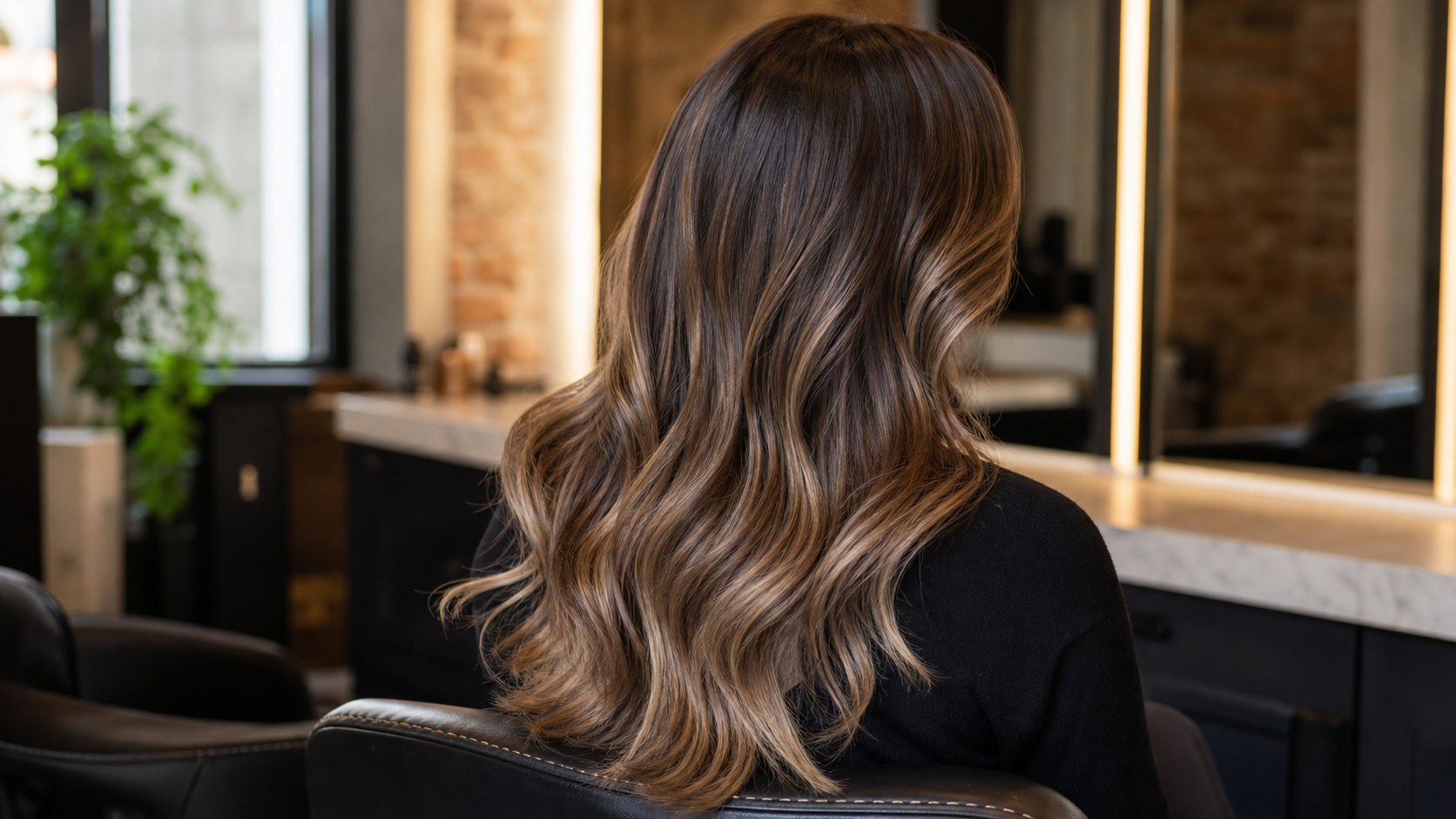
If you want the full magazine-cover look with bright, dimensional lengths and a soft shadowy root that looks like money, you want both. This is what most of our colour clients are actually asking for, even when they come in using only one of the two words. The balayage does the lifting. The melt does the polish. That combination is what holds up for four months in Denver and still looks intentional.

If you have very fine hair, we talk about placement before we talk about technique. Both balayage and colour melting can work on fine hair, but the difference between a colourist who paints lightness like it’s artwork and one who paints it like a recipe is more visible on fine hair than on thick hair. Hair that’s in rough shape (previously coloured at home, over-lifted, box-toned) usually gets a conservative melt first to correct what’s there, and we talk about balayage at the next appointment once we know the condition can take it.

On dark brunette and black hair, colour melting reads beautifully because the contrast between root and mid-length can be controlled precisely. A warm caramel melt through cool espresso, or a smoky charcoal grown in from ink black, lands differently on dark hair than a ribboned balayage would. If you’re dark-haired and you’ve been told balayage “won’t work” on you, that was probably about colour placement and lift time more than the technique itself, but a colour melt is often a gentler way to get into the lifted world.

Inside the Appointment

What to expect when you book

Your consultation is where we decide which technique or combination makes sense. We look at your current level, the condition of your hair, what your regrowth cycle looks like in real life, how often you wash, and what you’re actually trying to get out of the appointment. Bring reference photos, especially if a specific word has been stuck in your head. Sometimes “balayage” turns out to be a melt, sometimes “I want a root shadow” turns out to need lift first.

A full balayage with a melt-finish typically runs 3 to 4 hours depending on hair length and how much lift we’re going for. A standalone colour melt on already-lifted hair runs closer to 90 minutes to 2 hours. We quote time and price honestly at consultation, no surprise charges at checkout.

Aftercare matters in Denver. The water here is hard, the altitude dries hair quickly, and UV at our elevation shifts tone faster than at sea level. We send everyone home with a routine that’s matched to the colour we just put in, because the difference between hair that holds for four months and hair that shifts to brass in six weeks is mostly what happens in the shower.

Common questions

Is colour melting less damaging than balayage?

It depends on the lift, not the technique. A colour melt that only uses deposit-only toner is gentler than lightening work of any kind. A colour melt that includes lift is essentially the same as any other lightening service in terms of how much stress is on the hair. Balayage and colour melting both get blamed for damage that usually comes from lift decisions rather than the painting method. We run bond-builder through every lightening service at Fluff to keep the hair intact.

Can I get a colour melt on dark hair?

Yes, and it’s one of the most striking looks we do. Deep brunette melted into warm caramel, or cool espresso rooted into a smoky mid-length, reads really beautifully on dark hair because the eye picks up the tonal movement without any harsh lines. The limits are about how much brightness you want at the ends. If you want genuinely light ends on dark hair, we need balayage underneath the melt.

How long does colour melting last compared to balayage?

Balayage lasts longer in the sense that the lift is permanent until it grows out. A client with balayage can comfortably wait 12 to 16 weeks before needing new lift. Colour melts fade on a faster cycle because toner is deposit-only: warmer melts shift in 8 to 10 weeks, cooler melts hold closer to 12 weeks. This is why clients who want the fullest look usually get balayage with a melt-finish every 14 to 16 weeks, and optionally drop in for a gloss refresh at the midpoint.

Can I switch from balayage to colour melting?

Absolutely, and you don’t have to start from scratch. If you have existing balayage that you want softened into a melt, we can do that as a standalone appointment. If you want to grow out the balayage entirely and move to a more uniform melted look, we plan that across two or three visits rather than trying to force it in one.

What does it cost?

Pricing depends on hair length, density, and how much lifting is involved. A standalone colour melt starts lower than a full balayage-with-melt because it’s shorter and uses less product. We quote a real number at consultation based on what we actually see, not a range. If you want a ballpark before booking, you can call or DM and we’ll walk you through it.

Book Your Colour

Let’s figure out which one you actually need

Book a consultation at Fluff in LoDo Denver. We’ll talk through what you want, look at your hair, and build the right combination of balayage and colour melting for the look you have in mind.

F
Fluff Concierge
Online • Ready to help